One Sermon or Two?

“Blessed are you who are poor, for yours is the kingdom of God.” Luke 6:20
“Blessed are the poor in spirit, for theirs is the kingdom of heaven.” Matthew 5:3
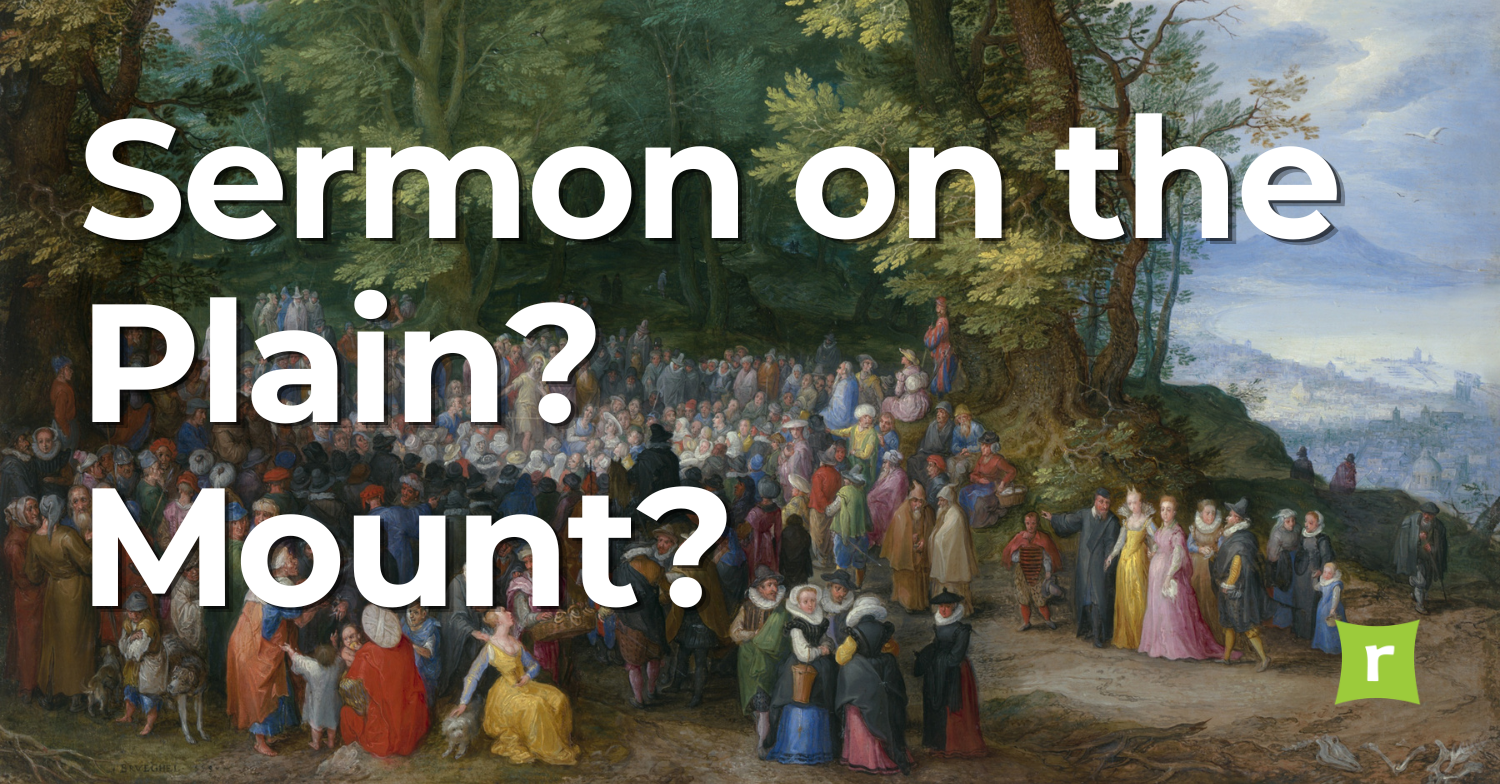
If you’re familiar with the words of Jesus, referring to His sermon in Luke 6:20–49 as “The Sermon on the Plain” may seem a bit strange. This is because it reads strikingly similar (even verbatim) to Jesus’ “Sermon on the Mount” in Matthew chs. 5–7.
Many Christian scholars have argued that they are the same sermon with Luke’s being highly edited for the purposes of his gospel. Christians have good reasons for thinking they are the same.
- The Sermon on the Plain begins and concludes in a very similar way to the Sermon on the Mount. Both begin with Jesus declaring a series of blessings. Both conclude with a parable about building your life on Jesus and His teachings (See Luke 6:46–49 and Matthew 7:24–27).
- “The Sermon on the Plain” in Luke contains nearly verbatim sermon points to “The Sermon on the Mount.”
- Both sermons seem to have been given in the same time period of Jesus’ life.
Because of these factors, it’s not irrational to assume that Luke and Matthew are recording edited versions of one and the same sermon preached by Jesus early in His public ministry.
Same Sermon?
However, while this may be the same sermon, I have some considerations that should help us slow down before we assume they are the same.
- Simply put, the location of this sermon is said to be different from the sermon in Matthew. Jesus seemingly goes to a “level place” to give this sermon (Luke 6:17). This does not seal the deal. Luke is compiling accounts of Jesus’ life, so there is a possibility that the location of the sermon starting in Luke 6:20 and the location of Jesus after coming down from the mountain (Luke 6:17) are not precisely chronological (Luke is writing an “orderly account,” not a precisely chronological timeline of Jesus’ life (Luke 1:1–4).
- Even if these are the same, we should be slow to assume that these sermons were included by Matthew and Luke for the exact same purpose. For example, while each sermon begins with a series of “blessings” (often called beatitudes), each Gospel makes quite a different point with them. Matthew emphasizes the spiritual nature of a true disciple (poor in spirit (Matthew 5:3). Luke emphasizes the poverty of the disciples in contrast with the dangers posed to rich disciples (Luke 6:24).
- Finally, while both sermons are very similar and both are placed in a similar timeframe in Jesus’ ministry, these truths do not immediately imply that these are the same sermon given at the same time. One thing very clear in Luke is that Jesus was an itinerant preacher (Luke 4:43). As an itinerant preacher, Jesus is just as likely to have had a consistent message that He preached. Further, Jesus certainly preached many, many sermons during this time period. Both Luke and Matthew only record one of them! Thus, it should not be surprising that he would preach a similar message.
Regardless of your view, I would strongly argue that this sermon in Luke should be read on its own. Even if “The Sermon on the Plain” is the same sermon given in Matthew 5–7, Luke has a unique goal in his Gospel for giving this sermon in its unique form. Just as each of the four Gospels, like facets on a diamond, give unique perspectives to the life and works of Jesus, so “The Sermon on the Plain” gives a unique perspective to Jesus’ preaching in the Gospel of Luke.